Manual assessment is slow and expertise-gated. Automated scanners alone produce noise without judgment.
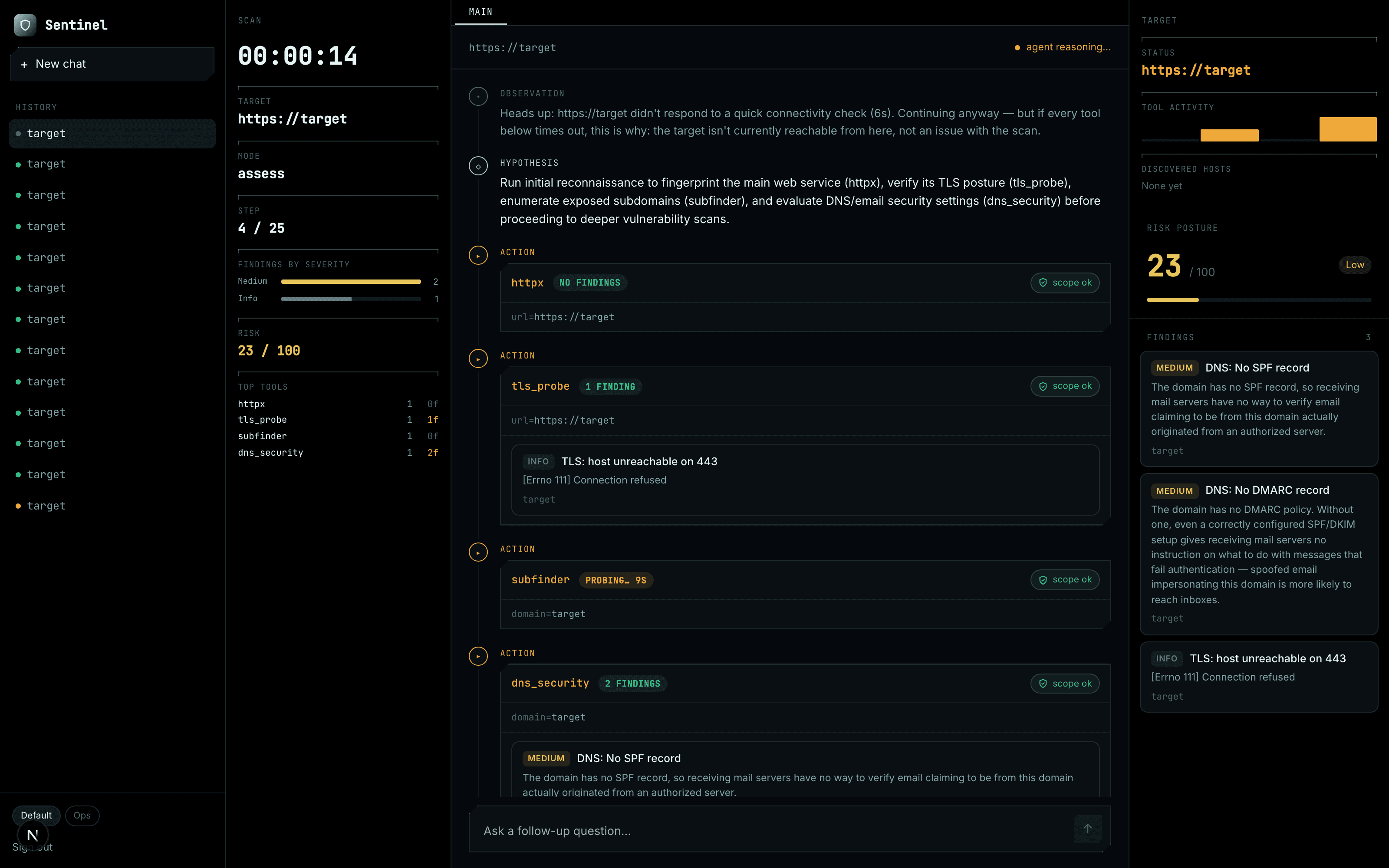
A real pentester reasons about a target — fingerprints it, forms a hypothesis, picks the next check based on what they just learned. A plain scanner just runs its whole list and hands you a report full of things that don't matter. Sentinel does the reasoning AND runs the real tools, so you get judgment and coverage, not one or the other.
Same real tools. None of the manual work.
Kali Linux is a toolbox — it doesn't decide what to run or read the output for you. Sentinel runs the same category of real, open-source tools, but the reasoning and orchestration are built in.
- ✕Install and maintain a VM loaded with hundreds of tools
- ✕Learn each tool's own CLI syntax and flags from memory
- ✕Decide what to run next yourself, every single time
- ✕Copy output between tools by hand — IPs from nmap into nuclei, hosts from subfinder into httpx
- ✕Read raw terminal output, tool by tool
- ✕No built-in scope check — one wrong flag can hit the wrong host
- ✕Write the report yourself, after the fact
- ✓Nothing to install — runs in your browser
- ✓One conversation: describe the target, it does the rest
- ✓An LLM agent picks the next tool based on what it just learned
- ✓Real output from nmap, nuclei, subfinder, katana, and 20 more — chained automatically
- ✓A live reasoning stream, in plain language, as it works
- ✓Scope gate blocks anything outside your verified target — before it runs, not after
- ✓Ranked findings with real remediation, ready when it's done
Four steps. No wall of raw scanner output.
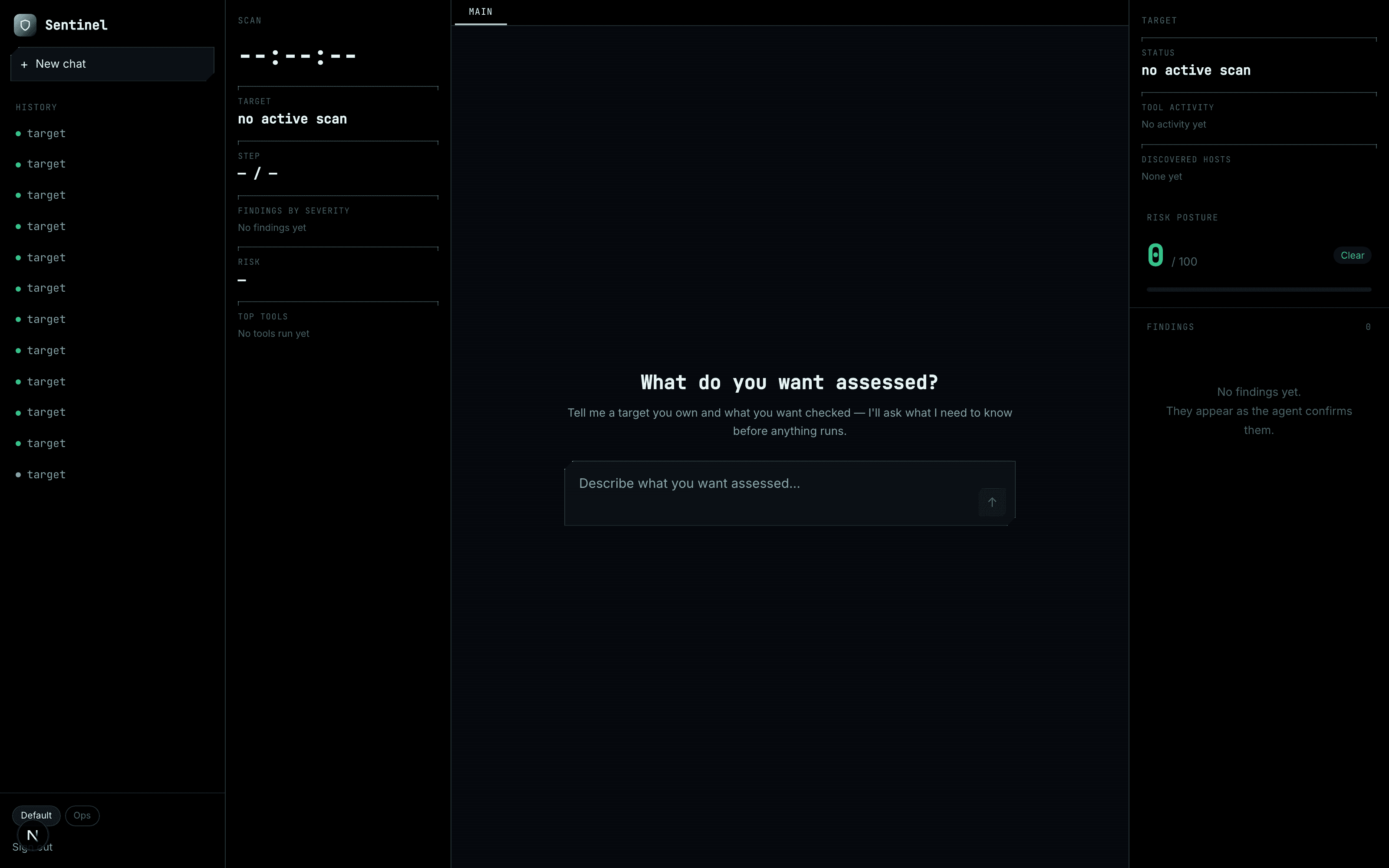
Describe the target
Tell it what you own and what you want checked. It asks what it needs to know before anything runs.
The agent reasons, live
An LLM agent picks the next tool based on what it's already learned — fingerprint first, then adapt: a confirmed WordPress install pulls in wpscan; a fingerprinted stack scopes nuclei's templates instead of running all 13,000+.
Real tools actually run
nmap, nuclei, subfinder, katana, and the rest execute for real, in a sandbox, against your verified target — not simulated, not mocked.
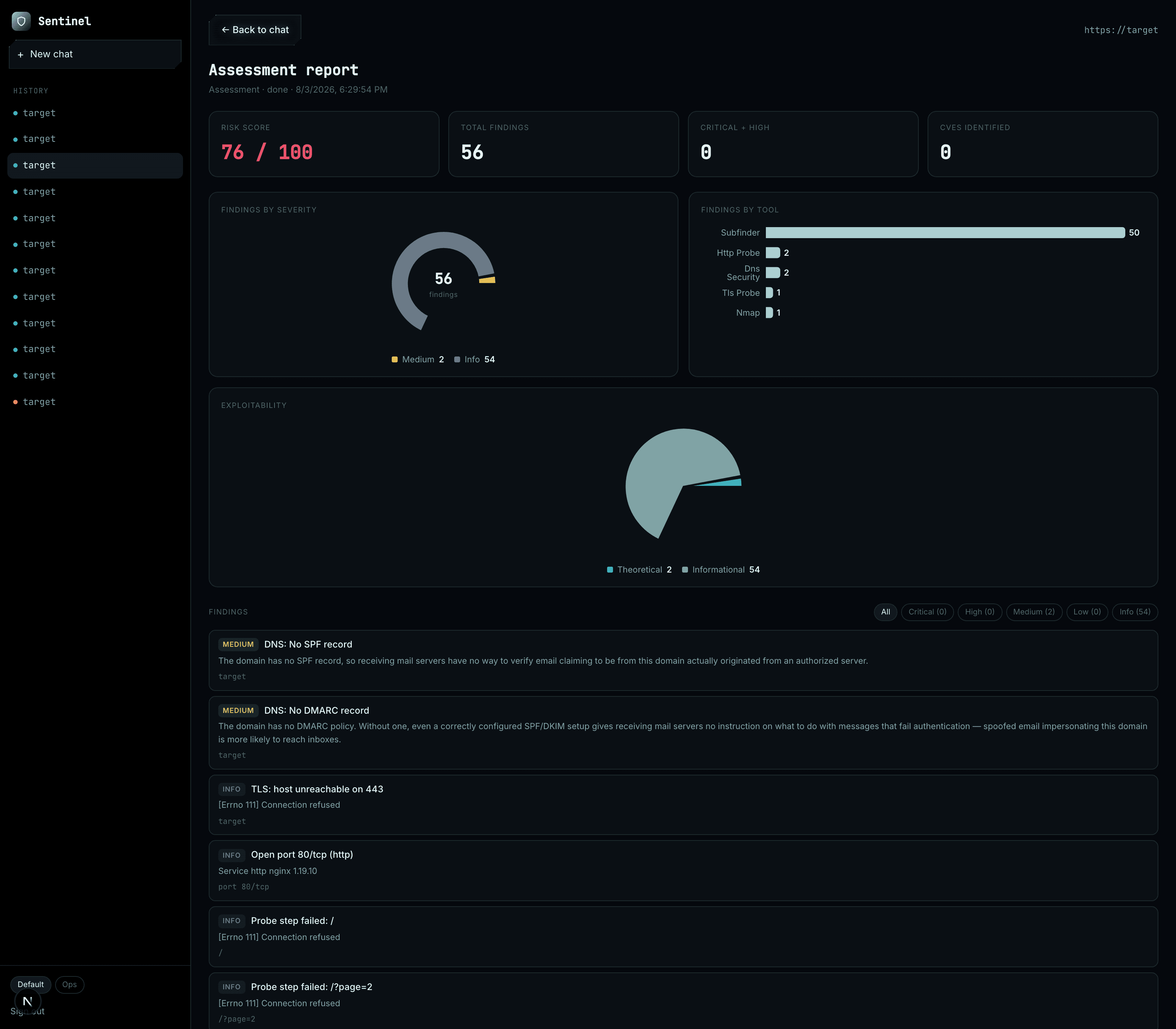
Ranked findings, real fixes
Every finding traces back to real tool output. Ranked by actual exploitability, with concrete remediation — not a wall of raw scanner noise.
24 real tools. Not a mock, not a wrapper.
20 run automatically once scope is verified. 4 exploitation-tier tools stay locked out unless you explicitly authorize active exploitation for that scan.
Port and service scanner — what's actually exposed, and what version.
Fast port sweep that runs ahead of nmap, so it knows where to look.
Template-matched CVE scanning, scoped to the fingerprinted stack.
Known-vulnerable server versions, dangerous files, risky HTTP methods.
Fast fingerprint pass — status, title, server, CMS, framework.
CMS, JS framework, web server, and language detection.
Active WAF fingerprinting — names the product, not just that one exists.
Deprecated protocols, weak ciphers, certificate trust issues.
CSP, X-Frame-Options, and other response-header hardening.
Passive subdomain enumeration, liveness-filtered automatically.
Deeper subdomain enumeration from a different source mix than subfinder.
JS-aware crawler — finds routes a wordlist would never guess.
Content discovery — exposed configs, .env/.git, backup archives.
SPF/DMARC/DKIM presence and strength, MX/NS posture.
Hardcoded API keys and tokens in pages and linked JS bundles.
Common GraphQL endpoints, tested for open introspection.
WordPress core/plugin/theme CVEs, exposed backups and debug logs.
Composable request sequences for one specific, reasoned check.
Reflected-Origin and null-origin CORS misconfigurations, credentials-aware.
S3/GCS/Azure buckets named after the target — flags the ones left public.
SQL injection testing against a parameter you have real reason to suspect.
XSS scanning that DOM-confirms real execution, not just an unescaped reflection.
OS command injection, confirmed by observing actual command execution.
The agent writes and runs a short sandboxed script for logic no fixed tool expresses.
Ranked findings, not raw scanner dumps
A real risk score, severity breakdown, and exploitability read on every finding — pulled straight from an actual scan, not a mockup.
An agent with real guardrails, not a hope
Scope gate, fail closed
Every tool call is checked against your verified assets by exact host match before it runs — not after. Nothing reaches a target you haven't proven you own.
Exploitation needs your explicit sign-off
Detection-tier tools (nmap, nuclei, nikto, and 17 others) run freely once scope is verified. Exploitation-tier tools (sqlmap, dalfox, commix, agent_script) stay locked out entirely unless you explicitly authorize active exploitation for that scan.
Sandboxed execution
Every tool run happens in an isolated, egress-restricted sandbox — including agent-written scripts, which run under a real Python sandbox (RestrictedPython), not a trust-the-model hope.
Append-only audit log
Every action, every target, every command — logged and never edited or deleted. You can always answer "what did it actually do."